What Is Stress Urinary Incontinence? Understanding Why It Happens and What You Can Do
Urinary leakage is more common than most people talk about, and for many men, it becomes a quiet but persistent part of daily life. Some days feel manageable; others do not, and the unpredictability of it can be frustrating and isolating. What often gets missed is that leakage is rarely random. It follows a pattern, and understanding that pattern is the first step toward feeling more in control.
Stress urinary incontinence can develop for a range of reasons, not just one. While prostate surgery is a well-known cause, SUI can also result from other urological procedures, nerve damage, anatomical changes, conditions like spina bifida or sphincteric incompetence, and more. Whatever the cause, the experience of living with it is often very similar, and so are the paths forward.
What Is Stress Urinary Incontinence?
Stress urinary incontinence is leakage that happens in response to physical pressure rather than a strong urge to urinate. When the pressure inside the abdomen rises suddenly, the urinary sphincter can momentarily lose its seal and allow urine to escape. It often catches people off guard precisely because there is no warning signal beforehand.
Common triggers include standing up, walking, lifting or bending, coughing, and sneezing. The leakage can range from a small drip to a more noticeable loss, and it can vary significantly from one day to the next.
SUI vs. Urge-Related Leakage: How to Tell the Difference
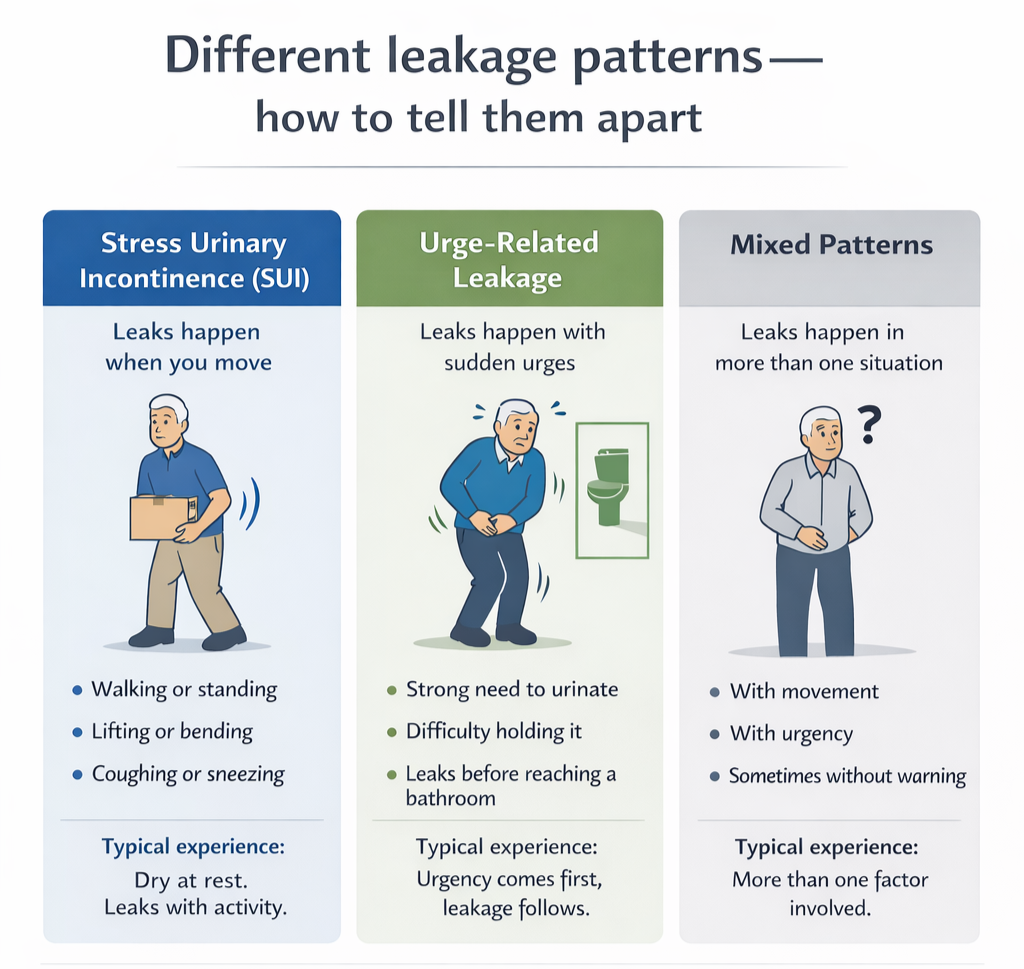
Not all urinary leakage is the same, and identifying which type you are dealing with matters. The two most common patterns are stress urinary incontinence and urge-related leakage, and they feel quite different.
To tell them apart, think about what happens right before the leak.
Stress Urinary Incontinence (SUI) happens with movement or physical pressure, with no strong urge beforehand. Common triggers are standing up, walking, lifting, coughing, and sneezing.
Urge-related leakage begins with a sudden, intense need to urinate that is difficult to delay. Leakage happens as the bladder contracts and forces urine out. Common triggers include hearing running water, approaching a toilet, or arriving home and unlocking the door.
Both patterns can exist at the same time, and how you are currently managing your symptoms may actually be making one or both of them worse without you realizing it.
Why does SUI persist?
Regardless of the original cause, SUI tends to persist for similar underlying reasons.
The sphincter works, but struggles under strain. The external urinary sphincter can often hold urine at rest but briefly loses control during movement. This is not a failure of the muscle. It is a load and endurance issue.
Movement creates sudden pressure. Activities like going from sitting to standing or walking at a pace increase abdominal pressure quickly. If the sphincter cannot respond fast enough or hold long enough, leakage happens even when overall muscle strength is reasonable.
Fatigue builds throughout the day. A very common pattern is minimal leakage in the morning that worsens as the day goes on. This strongly points to sphincter fatigue rather than any worsening of the underlying condition. The muscle is simply tiring out.
When Exercises Alone Are Not Enough
Pelvic floor exercises are often the first recommendation, and in many cases, they genuinely help early on. But for some men, continuing the same approach over time can increase fatigue, encourage constant clenching, and reduce coordination during movement. At a certain point, recovery becomes less about force and more about support and timing.
When leakage follows a consistent pattern, it stops feeling random and starts feeling manageable. That shift in understanding alone can make a meaningful difference.
What You Can Do Next
SUI tends to follow predictable patterns that are often unintentionally made worse by typical management habits. The good news is that once you understand what is driving your symptoms, there are meaningful steps you can take regardless of how long you have been living with it.
A personalized continence assessment can confirm what is behind your leakage, identify what can be improved in your current approach, and outline what other support options are available to you.
Talk with a Contino® Consultant. Our team will take the time to understand your specific situation, why progress may have stalled, what you can do differently, and what other options are available. You do not have to keep managing this alone.
Are You Looking to Stop Bladder Leakage?
Book a free telephone consultation with one of our nurses to see if the Contino® device is a good fit for you.
Book Now